In the last two decades, plagiarism has become a serious issue in the academic environment all over the world, which concerns the public and educators. Each country has their own policies regarding plagiarism. In most Asian and Middle East countries, students do not need to cite the famous quote from politic or religion. The professors must understand that information and where it come from. However, in English speaking countries, especially the United States, plagiarism is a serious problem and it is monitored strictly to ensure the transparency of resources and authors.

So, what is plagiarism? In its basic definition, plagiarism is an act of fraud, it involves both stealing someone else’ work and lying about it afterward (Plagiarism, 2017). Plagiarism can be divided into to two forms, which are plagiarism purposely and unpurposely.
Plagiarism purposely occurs when an author use another author’s work or research and claim it as his own. This deed includes copying the whole text, copying partial content, or putting numerous original sources into one’s work without citing the author(s). On the other hand, plagiarism unpurposely refers to the act of utilizing original work and citing the authors incorrectly. The reason could be the lack of knowledge or simply too lazy to cite the authors. In reality, there are many arguments and conflicts regarding plagiarism, which is called “grey area”. For example, an author wants to collect information from a conversation, this kind of information sometime is too unofficial to cite. In addition, the common knowledge is also in this “grey area” because defining common knowledge is not always easy. For instance, “the earth is round and spinning around the sun”, to most readers this information is basic information, there is no need to cite this information, but to other people, this information needs to be proved and cited.
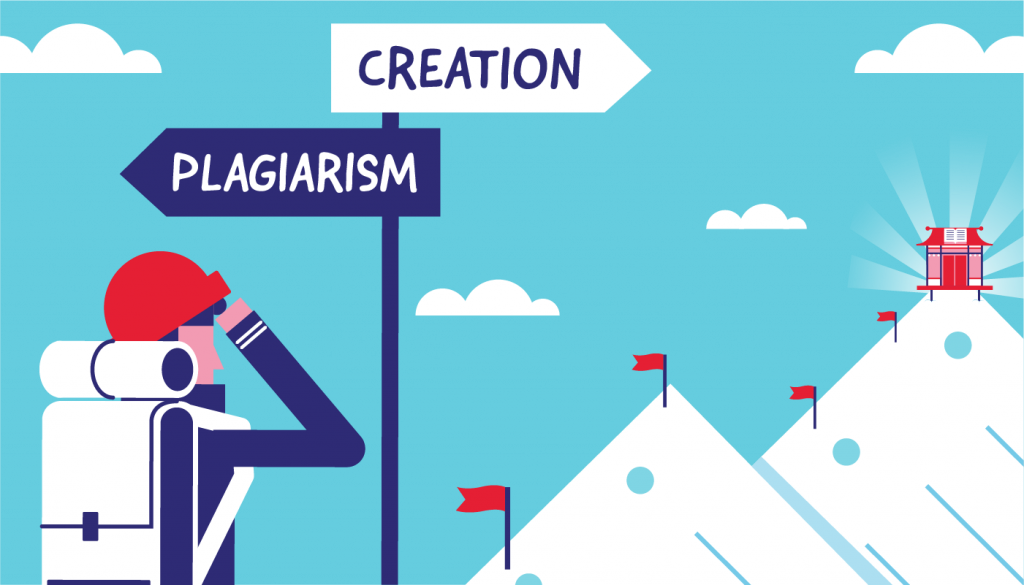
In the United States’ academic environment, the penalty for plagiarism is rather severe, a student who plagiarized his work can be punished from receiving an F for the course or suspend from the school. More strictly, this action can be recorded and will stay in students’ transcript forever, which reduce their reputation severely in the future (when applying for a job for example) (Vos, 2017). Plagiarism can be spotted by many approaches. An experienced professor can spot plagiarism easily when reading a paper. Moreover, most universities in English speaking countries now have software to detect plagiarism such as “Turnitin”. When students submit their works to the system, it will compare and distinguish the similarity between the students’ work and other people’s work on the Internet and its database (Young-Pwell, 2017). If an individual is revealed to plagiarizing other people’s work, his reputation, career and future development will be affected severely.
In conclusion, plagiarism is a serious offence and will be punished accordingly. Therefore, students should be aware of it and avoid plagiarism at all cost.
Bibliography
Plagarism. (2017). What is Plagiarism? Retrieved from Plagiarism.org: https://www.plagiarism.org/article/what-is-plagiarism
Vos, L. (2017). Plagiarism and American Academia. Retrieved from Study in the USA: https://www.studyusa.com/en/a/1612/plagiarism-and-american-academia
Young-Powell, A. (2017). How serious is essay plagiarism? Retrieved from The guardian: https://www.theguardian.com/education/2017/dec/30/is-plagiarism-really-a-growing-problem-in-universities

 Trang's Blog - Media Law